Company 6 July 2026 · 6 min read
Coricelli opens its new facility in Spoleto
An investment of over 13 million euros in innovation, sustainability, and the future of the Italian olive industry.
Pietro Coricelli’s new production plant was inaugurated on Friday 3 July. This strategic investment marks a new phase of growth for the historic Umbrian olive oil company and reaffirms its commitment to innovation, sustainability and development within the extra virgin olive oil sector. The event brought together institutions, representatives from the agricultural sector and the business world for a discussion focused on the future of the Italian agri-food supply chain.
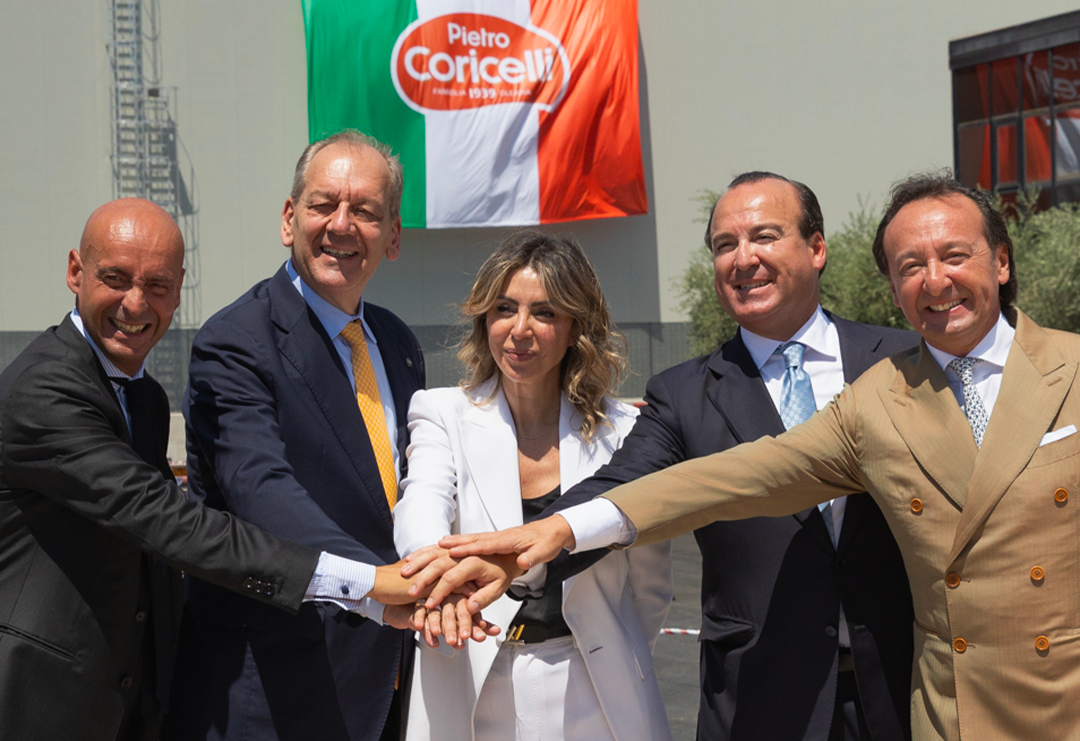
Guests were welcomed by Chiara Coricelli, Chair and Chief Executive of Pietro Coricelli. The opening ceremony took place in the presence of Senator Patrizio Giacomo La Pietra, Under-Secretary of State at the Ministry of Agriculture, Food Sovereignty and Forestry; Luigi Scordamaglia, Chief Executive of Filiera Italia; Salvatore Caiata, Member of Parliament and Chair of the Italian Delegation to the Parliamentary Assembly of the Central European Initiative. Representatives from regional and local authorities also took part in the event, confirming the local community’s interest in the company’s growth trajectory.
The morning began with a tour of the refurbished plant, during which guests were able to gain a first-hand insight into the production processes, the technological solutions adopted and the measures implemented by the company to increase production capacity, logistics and energy efficiency, whilst at the same time strengthening quality control. The project involved a total investment of over 13 million euros across an operational area of 100,000 square metres, confirming the company’s commitment to continuing to invest in the local area and in the competitiveness of ‘Made in Italy’ products. The projects carried out include new storage facilities for 4,200 tonnes of extra virgin olive oil, the expansion of the finished product warehouse, a new bottling line, the modernisation of the laboratory and three photovoltaic systems, with a total capacity of approximately 640 kWp.
“The opening of the new plant marks an important milestone in Pietro Coricelli’s growth journey and is a concrete demonstration of our commitment to continuing to invest in Italy, strengthening production capacity, innovation and quality,” said Chiara Coricelli, Chair and Chief Executive of Pietro Coricelli. “We have chosen to make a significant investment because we believe in the future of olive oil and in the potential to revitalise the sector in the markets, responding ever more effectively to consumer needs and the challenges of competitiveness. To achieve this, it is essential to build solid synergies throughout the supply chain, fostering dialogue between the agricultural sector, industry and institutions. The presence of Under-Secretary La Pietra, MP Caiata and Chief Executive Scordamaglia confirms the focus on a sector that is strategic for ‘Made in Italy’ and reinforces the conviction that it is only through concrete collaboration between business, politics and the agricultural sector that value can be generated for the local area and for the country.”
The day was further marked by the opening of the new roundabout built in front of the production site, symbolically celebrated with a ribbon-cutting ceremony and a tricolour smoke display.
The delegation then moved on to Casa Coricelli, where an institutional round-table discussion was held on the prospects for the olive and olive oil sector. During the debate, a number of key issues for the sector’s growth were addressed: the value of the supply chain as a factor in competitiveness, the need to strengthen collaboration between agriculture, industry and institutions, the protection and promotion of ‘Made in Italy’, and the prospects for the Italian agri-food sector over the next decade. Also at the heart of the debate were the policies needed to support investment, encourage innovation and make the national production system increasingly competitive on international markets. In this context, the need to involve the downstream supply chain more closely – starting with modern retail – also emerged strongly, recognising that the trade plays a central role in creating value for extra virgin olive oil. Only through a more structured dialogue between producers, the industry and distributors will it be possible to enhance the product range, better meet consumers’ needs and strengthen the sector’s market position.
Senator Patrizio Giacomo La Pietra, Under-Secretary of State at the Ministry of Agriculture, Food Sovereignty and Forestry, spoke to highlight the strategic value of the olive oil sector for the ‘Made in Italy’ agri-food industry and the importance of supporting innovation and generational renewal: “The olive oil sector is of strategic importance to the ‘Made in Italy’ agri-food industry, and in particular our extra virgin olive oil represents a true Italian excellence. It is a sector in which we at MASAF and the Meloni government firmly believe, as evidenced by the 300 million allocated to the sector under the ‘Coltivaitalia’ programme, through which we aim to modernise our businesses and facilitate the entry of young people and women into the labour market. Innovating whilst keeping a clear understanding of our roots and how we have worked over time is the key to addressing the future of the olive oil sector, and the Coricelli company stands as a concrete example of this.”
Salvatore Caiata, Member of the Italian Parliament and Chair of the Italian Delegation to the Parliamentary Assembly of the Central European Initiative, also highlighted the value of a business model capable of combining Italian roots, innovation and an international vision: “We were fortunate enough to visit a company that embodies the true spirit of ‘Made in Italy’. That is to say, combining tradition with innovation through vision. Institutions have a duty to support these companies, which do not merely endure globalisation but take the lead – even at an international level – in acquisitions that safeguard historic Italian brands, whilst maintaining a high profile of ‘Italianness’.”
Luigi Scordamaglia, Chief Executive of Filiera Italia, spoke on the value of investments aimed at safeguarding the supply chain and on the central importance of transparency as a driver of competitiveness for ‘Made in Italy’ products: “Investments such as this, in tools designed to enhance the entire supply chain, allow us to look to the future of our sector with optimism. Globally, demand for ‘Made in Italy’ products is growing steadily, as is interest in this extraordinary product, which is a guarantee of longevity. To combat the rising incidence of identity theft – and thus the economic and social value being siphoned off from our production supply chain – documentary transparency, full real-time digital traceability and the use of the most advanced analytical techniques available (isotopic mapping and magnetic resonance imaging) are essential tools for identifying those who operate outside the rules. At the same time, these safeguards serve to highlight, by contrast, the commitment of those who, with pride and hard work, continue to produce and market authentic Italian olive oil, guaranteeing consumers a product of the highest quality.”
The initiative confirmed Pietro Coricelli’s role as a leading figure in the Italian olive oil sector and highlighted how dialogue between businesses, the agricultural sector and institutions is a key driver in tackling the challenges facing the sector: from innovation to sustainability, from promoting domestic produce to boosting the competitiveness of ‘Made in Italy’ products.
Tags
Share
Related Articles
Coricelli strengthens its international growth
Over 78 million litres of oil sold: exports soar to 58%.
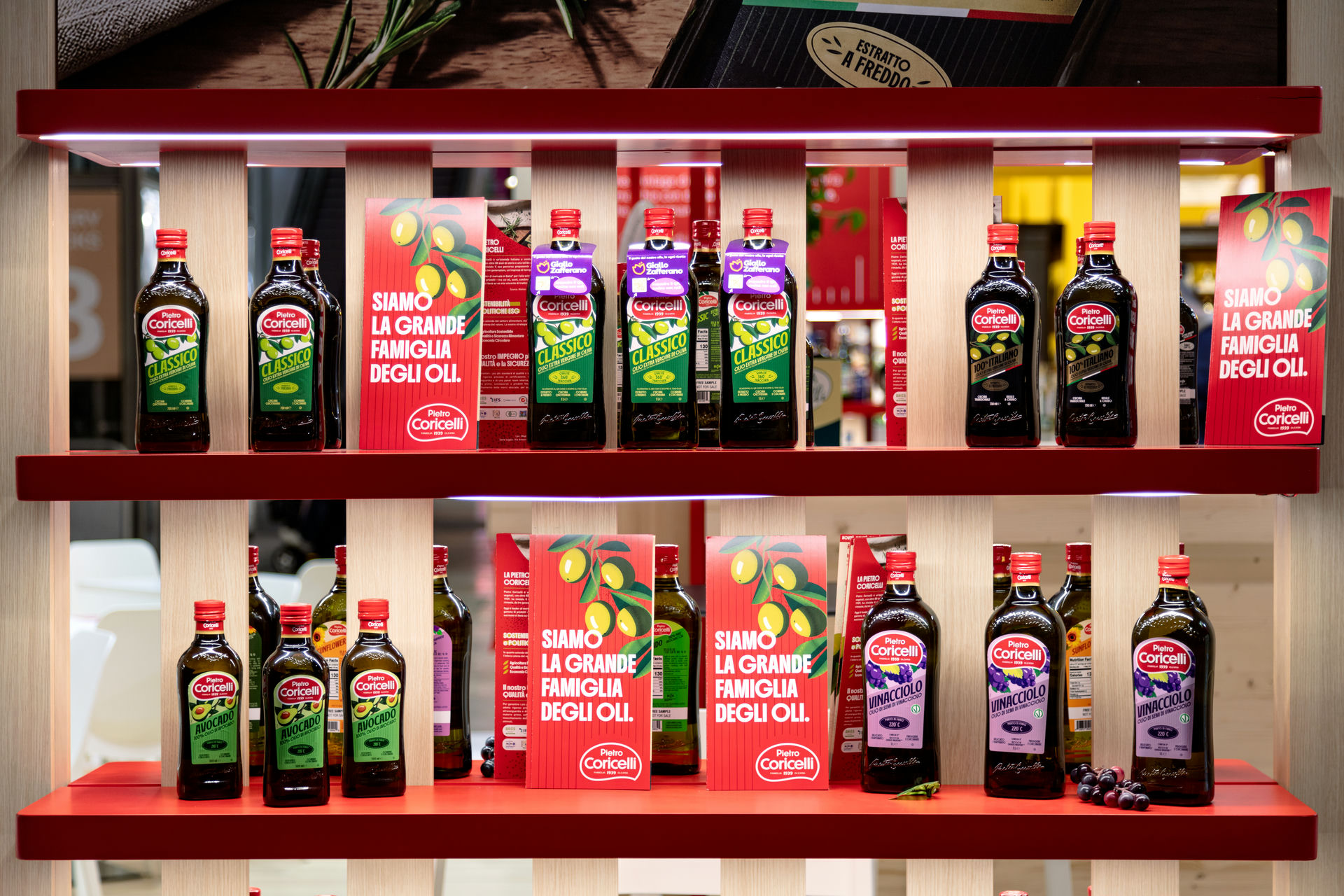
Pietro Coricelli at TuttoFood 2026 with a new look
A rebranding project that brings together contemporaneity and history.
Coricelli and GialloZafferano together for 2026
A partnership dedicated to inspiring quality Italian cuisine, every day.